
Abiy Ahmed’s Reappointment Speech: Sea Access, Constitutional Change and Regional Air Superiority Take Center Stage as Questions on War and Peace Remain
By UMD Media / Oct 5, 2026 / 4 min read
October 5, 2026
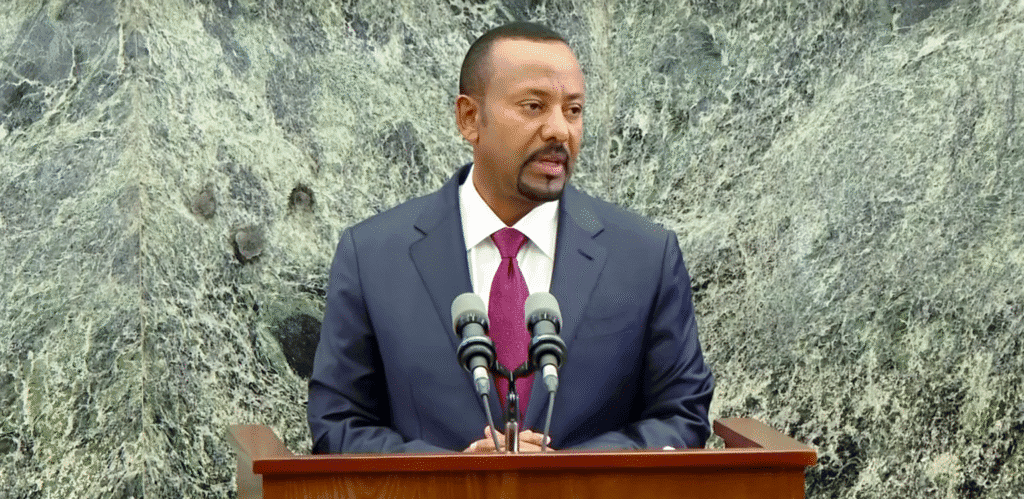
Ethiopian Prime Minister Abiy Ahmed offered few specific details about his government’s plans for the next five years in a roughly 50-minute speech delivered after his reappointment as prime minister on Monday.
Abiy was reappointed for another five-year term as Ethiopia’s seventh parliamentary term formally opened, extending his premiership to 2031.
While much of his address focused on broad political, economic and national ambitions, several statements stood out for their potential domestic and regional significance.
Ethiopia to Assert Regional Power “Through Its Strength”
Abiy said Ethiopia would not simply remain an “anchor country” in the Horn of Africa but would establish itself as a country capable of determining regional affairs through its own power.
“Ethiopia will demonstrate that it is not only an anchor country in our region, but also a country that has a decisive role in regional affairs—not through the generosity of others, but through its own strength.”
Constitutional Amendment
Abiy also announced that constitutional amendments would be pursued during the coming period, linking the process to recommendations emerging from Ethiopia’s National Dialogue.
“In the coming period, there will be constitutional amendments based on the recommendations of the National Dialogue.”
He did not provide details on which provisions of the constitution could be amended, when the process would begin, or how proposed changes would be approved.
Sea Access Remains a Priority
Abiy again placed access to the sea among his government’s major strategic objectives.
“Ethiopia’s development cannot be fully realized without access to the sea. Based on the principle of give and take, we will work tirelessly so that Ethiopia will have an outlet and access point.”
His comments reaffirmed a position he has repeatedly advanced in recent years—that landlocked Ethiopia requires reliable maritime access for its long-term economic development. Reporting on Monday’s speech also highlighted sea access as one of the clearest priorities identified for his new term.
Ethiopia to Build Regional Air Superiority Capability
In another potentially significant statement, Abiy said Ethiopia intends to develop the capability necessary to establish air superiority in the region.
“Ethiopia will build the capability necessary to establish air superiority in our region.”
He did not elaborate on what such a capability would involve, its timeframe, planned military acquisitions, or the countries against which Ethiopia measures its regional air-power ambitions.
The statement comes at a particularly sensitive moment in the Horn of Africa, amid renewed fighting in Tigray and heightened tensions involving Ethiopia and several neighbouring states.
Despite the wide-ranging speech, Abiy provided limited concrete detail on how his government intends to implement many of its stated objectives during the five-year term.
The clearest signals were therefore strategic rather than programmatic: constitutional change at home, continued pursuit of sea access, an ambition for regional air superiority, and a declaration that Ethiopia intends to assert greater influence in the Horn of Africa through its own national power.
Unanswered Questions and Contradictions
The speech also left major questions unanswered about Ethiopia’s immediate security crisis. Abiy delivered his vision as renewed fighting involving federal forces and Tigray Defence Force continues to raise fears of another prolonged war, civilian displacement and a wider regional confrontation. Federal and allied Tigray Peace Force have recently re-entered Mekelle, while fighting has also affected areas beyond Tigray.
Against that backdrop, critics question the emphasis on regional power, maritime access and building “air superiority” without a similarly detailed roadmap for ending Ethiopia’s internal wars, implementing outstanding provisions of the Pretoria peace agreement, addressing displacement, restoring humanitarian access and creating a sustainable political settlement.
His renewed emphasis on Red Sea access could also attract scrutiny from neighbouring states. Just a day before his speech, regional coastal countries reiterated that responsibility for Red Sea affairs rests with littoral states, amid growing concern that competing maritime and security ambitions could further destabilize the Horn. Abiy nevertheless repeated that Ethiopia’s development requires access to the sea and said his government would pursue it through a “give-and-take” arrangement.
The combination of that maritime ambition with his declaration that Ethiopia intends to develop regional air-superiority capability could therefore be interpreted in two very different ways: by supporters as a statement of national strategic preparedness and self-reliance, and by critics or neighbouring governments as an increasingly militarized vision of Ethiopia’s regional role.
Another unanswered question concerns constitutional reform. Abiy said amendments would follow recommendations emerging from the National Dialogue, but gave no indication of which constitutional provisions could change, how competing political forces would participate, or whether reforms could command broad legitimacy while several major armed and political actors remain outside the process.
The central contradiction in the speech may therefore be between ambition and immediate reality: Abiy described an Ethiopia capable of shaping the Horn of Africa through its economic and military strength, while the country itself remains confronted by renewed war, unresolved territorial and political disputes, displacement and an increasingly volatile regional environment.