
Drone Strike in Tigray Destroyed Humanitarian Aid Truck Bound for Sheraro IDP Camp: Catholic Eparchy of Adigrat Says
By UMD Media / Sep 21, 2026 / 5 min read
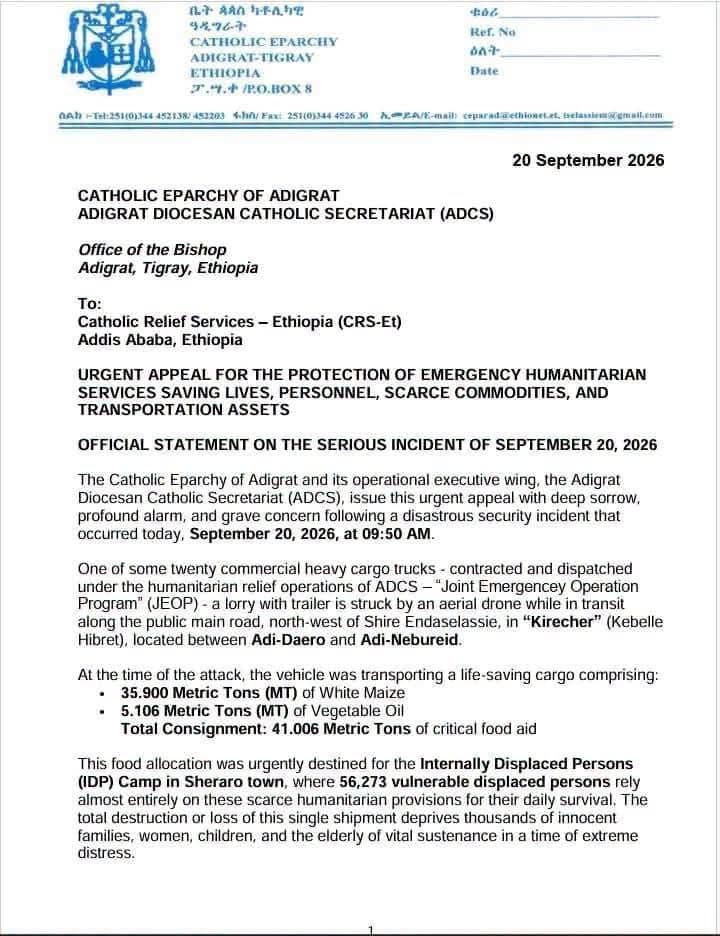
The Catholic Eparchy of Adigrat has issued an urgent humanitarian appeal after what it described as an aerial drone strike on a truck transporting emergency food assistance to internally displaced people in Sheraro, northwestern Tigray.
In an official statement dated September 20, 2026, the Catholic Eparchy of Adigrat and its operational arm, the Adigrat Diocesan Catholic Secretariat (ADCS), said the incident occurred at approximately 9:50 a.m. on September 20.
According to the statement, one of about 20 commercial heavy cargo trucks contracted for the ADCS Joint Emergency Operation Program (JEOP) was hit while travelling along the main public road northwest of Shire Endaselassie. The location was identified as Kirecher, Kebele Hibret, between Adi-Daero and Adi-Nebureid.
More than 41 metric tons of food reportedly lost
The truck was carrying emergency food supplies consisting of:
- 35.900 metric tons of white maize
- 5.106 metric tons of vegetable oil
- 41.006 metric tons in total
The aid was destined for an internally displaced persons camp in Sheraro, where the Eparchy says 56,273 displaced people depend heavily on humanitarian assistance.
The organization warned that the destruction of even a single shipment could have serious consequences for displaced families, particularly women, children and elderly people already facing severe hardship.
The ADCS described humanitarian transport equipment and emergency supplies in Tigray as both scarce and difficult to replace, arguing that attacks or interference with relief operations increase the suffering of civilians.
Appeal for protection of humanitarian operations
Bishop Abune Tesfaselassie Medhin, Bishop of the Catholic Eparchy of Adigrat, appealed to authorities, security actors and other stakeholders to protect humanitarian personnel, supplies and transportation.
The Eparchy called for what it described as absolute respect for international humanitarian law, stressing that humanitarian assistance should remain neutral, impartial and independent.
It specifically called for protection of humanitarian workers, relief commodities, vehicles, supply routes and transit corridors from attack, harassment or interference.
The statement also urged relevant authorities and security actors to establish “clear, reliable, and respected safety guarantees” that would allow ADCS, Catholic Relief Services–Ethiopia and other humanitarian organizations operating in Tigray to reach vulnerable communities without obstruction.
Church calls for de-escalation
The Catholic Eparchy also appealed to all parties to avoid actions that could endanger civilian lives, damage basic infrastructure or obstruct emergency humanitarian operations.
It called for de-escalation and the preservation of human life, saying humanitarian needs should take priority regardless of political or security tensions.
The Eparchy said it would work with Catholic Relief Services–Ethiopia, Caritas Ethiopia, international humanitarian partners and government authorities to review security procedures, determine the extent of the losses and try to ensure continued assistance to the displaced population in Sheraro.
Warning over wider humanitarian situation
Beyond the September 20 incident, the statement drew attention to the broader humanitarian situation in Tigray.
The Eparchy stated that more than one million internally displaced people remain in camps, while approximately 1.7 million people have returned without receiving adequate support, many from areas of western Tigray.
It also warned that parts of Tigray are experiencing what it described as extreme El Niño-related drought conditions, affecting both people and livestock and increasing the urgency of uninterrupted humanitarian assistance.
The Church concluded its appeal by calling for peace, wisdom and restraint among all parties.
Copies of the statement were addressed to the Archbishop of Addis Ababa, the Apostolic Nunciature, Caritas Ethiopia, international humanitarian partners and donors, relevant United Nations agencies and humanitarian organizations, and government and security authorities.
Latest in a Series of Drone Strikes Across Tigray
The September 20 attack comes after a series of reported drone strikes across Tigray during August and September, including strikes on residential areas, schools, agricultural zones and other civilian infrastructure.
In September, local authorities and Tigray media reported drone strikes on Zikre Suwat Primary School in Korem on September 12 and Meskote Brhan Primary School on September 13, both in Southern Tigray. The reports said school property was damaged. The federal government had not publicly provided a detailed account of those specific incidents.
The September incidents followed a particularly intense sequence of reported attacks in August. On August 20, two drone strikes were reported in Mekelle. One struck the Da’ero/Hawelti residential area near St. Mary Church, where Ayder Specialized Hospital said it received 13 casualties, including adults and children. Another strike was reported in the Kuha area. Tigray regional authorities attributed the attacks to Ethiopia’s federal forces, while the federal government had not publicly acknowledged responsibility for those specific strikes.
Additional strikes were subsequently reported in several parts of the region. On August 24, drone attacks were reported in Genete, Raya Azebo, and Endabaguna in northwestern Tigray. On August 25, another strike was reported in Atsbi Wemberta in Eastern Tigray.
On August 26, local sources reported strikes in Genete, Raya Azebo, and at Gijet General Secondary School in Saharti district. The Tigray Education Bureau later said the Gijet strike destroyed classrooms and an ICT facility containing 35 computers supplied through a World Bank-supported education program.
Earlier in the month, a August 10 strike reportedly damaged Merewa General Secondary School in Raya Alamata, while a August 18 strike was reported at a farmers’ training centre in Dandera, near Mekelle.
The September 20 incident is therefore notable not only because another drone strike was reported, but because the target described by the Catholic Eparchy was a humanitarian relief convoy carrying more than 41 metric tons of food for tens of thousands of displaced people. Unlike some earlier incidents, where regional authorities alleged that civilian locations were hit while other accounts said federal operations were directed at military targets, the Eparchy’s statement describes the September 20 vehicle specifically as a commercial truck operating under a humanitarian relief program.
The Catholic Eparchy itself does not identify who operated the drone, unlike other Tigrayan institutions and media outlets that have attributed previous strikes to the Ethiopian federal government.