
Eritrea Warns of UAE-Israel-Ethiopia Strategic Alignment in Horn of Africa
By UMD Media / Sep 12, 2026 / 4 min read
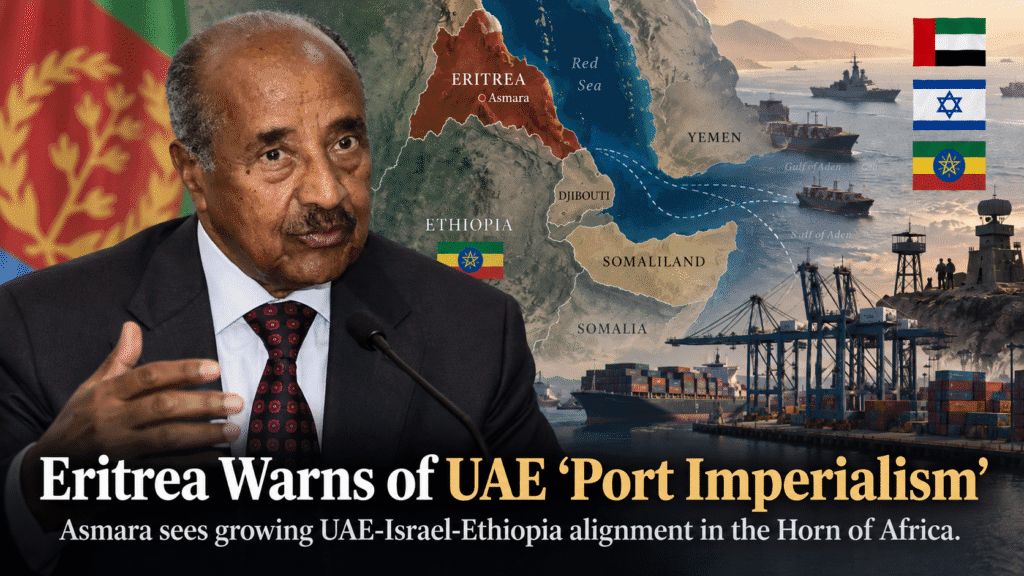
Eritrea’s Foreign Minister Osman Saleh has accused the United Arab Emirates of pursuing what he described as "port imperialism" across Africa, while warning that Asmara sees an emerging strategic alignment between the UAE, Israel and Ethiopia in the Horn of Africa.
Saleh made the remarks in an exclusive interview with Middle East Eye in Asmara. The published article is not presented as a full question-and-answer transcript, but the main questions can be reconstructed from Saleh’s quoted responses.
On the UAE’s growing network of ports and logistics facilities across Africa, Saleh questioned whether Abu Dhabi’s objectives were purely commercial.
"The UAE has port facilities everywhere in the region, and African countries have to ask why. Is it just for economics? No."
Saleh characterized the UAE’s expanding port presence as a form of "port imperialism," arguing that some of the facilities also serve broader strategic and military objectives.
Eritrea itself previously permitted the UAE to establish a military presence at Assab during the Yemen war, but relations later deteriorated. Asked why Asmara rejected a more permanent Emirati role, Saleh said:
"We didn’t want DP World [in Eritrea]. We do not want any foreign power to have a ‘hub’ in Eritrea."
According to Middle East Eye, a senior Eritrean official also said Asmara rejected a UAE request around 2016 to establish a military base on one of the islands of the Dahlak Archipelago. The proposed facility was reportedly intended to be shared by the UAE and Israel, several years before the two countries publicly normalized relations under the Abraham Accords.
Saleh also linked Eritrea’s concerns about the UAE to what Asmara views as increasing coordination between Abu Dhabi and Israel in the Horn.
"The UAE and Israel have already converged on Somaliland," Saleh said.
According to the report, Eritrean officials believe a similar alignment is increasingly taking shape around Ethiopia and the government of Prime Minister Abiy Ahmed.
Saleh described Abiy’s regional ambitions in unusually direct terms.
"[Abiy Ahmed] has a two-waters strategy like Israel. Only for him it is from the Nile River to the Red Sea."
The remark appears to reflect Eritrea’s concern that Ethiopia’s campaign for Red Sea access is connected to a wider geopolitical strategy rather than being limited to commercial access to ports.
Ethiopia has repeatedly emphasized its need for reliable access to the sea, while Eritrea has indicated that it is open to commercial arrangements. Asmara, however, strongly objects to arguments that appear to question Eritrea’s territorial sovereignty or frame Ethiopian access in historical or territorial terms.
Saleh also raised concerns over Israel’s expanding involvement in the Horn of Africa, particularly in Somaliland.
"We have to ask why Israel is running to control the Horn of Africa? Why do they need a base in Somaliland?"
Somaliland has developed increasingly close relations with the UAE, while its officials have also expressed interest in deeper Israeli engagement. For Eritrea, the overlap between Emirati port interests, military infrastructure and Israeli strategic interests appears to be a central concern.
Asked whether Asmara believes the UAE and Israel are coordinating their regional strategies, Saleh again pointed to Somaliland.
"They already converge on Somaliland."
The Middle East Eye report says Eritrean officials now believe the UAE and Israel are also coalescing around Ethiopia, at a time when relations between Addis Ababa and Asmara have sharply deteriorated.
Eritrea and Ethiopia fought together against the Tigray People’s Liberation Front during the 2020-2022 war in northern Ethiopia, but that tactical partnership has since broken down. The two governments are now increasingly at odds over regional security, Ethiopia’s demand for sea access and accusations surrounding armed groups operating in the region.
Saleh also revealed how far Eritrea’s once-close diplomatic relationship with Israel has declined.
"We decided we didn’t want their [Israeli] embassy here. We are not antagonistic to Israel, but we just decided we didn’t want any relations."
The statement suggests that Eritrea does not formally define Israel as an adversary, but has deliberately distanced itself diplomatically as its concerns over Israeli regional policy have grown.
Taken together, Saleh’s remarks present Eritrea’s current reading of the regional balance of power: Asmara sees the UAE’s port investments as part of a strategic network extending beyond commerce, views Israel’s growing engagement in Somaliland with suspicion, and increasingly sees UAE and Israeli interests converging with those of the Ethiopian government.
For Eritrea, the central concern is therefore no longer simply Ethiopia’s demand for Red Sea access. It is the possibility that Ethiopia’s ambitions are becoming embedded within a broader UAE-Israel strategic architecture stretching across the Red Sea and Horn of Africa.