
Tigray Leader Debretsion Gebremichael Signals Protracted, Mobile War Strategy as Fighting Expands
By UMD Media / Oct 1, 2026 / 4 min read
October 1, 2026
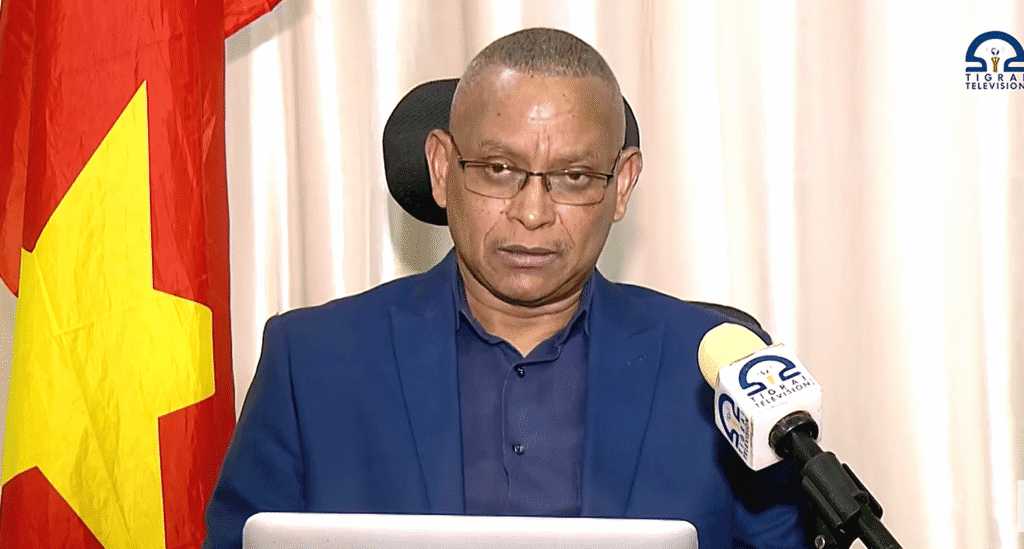
Tigray President and TPLF Chairman Debretsion Gebremichael made his first televised appearance since the latest fighting escalated on September 23, delivering a roughly 12-minute Tigrigna statement on Tigray TV in which he sought to reassure the public over recent territorial losses and signaled that the current defensive phase would eventually be followed by counteroffensive and offensive operations.
Debretsion described the renewed conflict as fundamentally political and blamed Prime Minister Abiy Ahmed and his government for its outbreak. He characterized the fighting as a continuation of the 2020–2022 war and alleged that outside powers, including the United Arab Emirates and other unnamed countries, were involved.
He argued that the conflict should now be understood as regional rather than solely Ethiopian, linking it to developments in Sudan and Ethiopia’s pursuit of access to the Red Sea. The wider regional dimension of the renewed conflict has also drawn growing attention from analysts as tensions involving Ethiopia, Eritrea and neighboring states intensify.
“Where and When to Hit, We Know”
Debretsion said Tigrayan forces were currently limiting their operations largely to defense but that this would not remain the case.
He said counteroffensive and offensive operations would come, adding that Tigrayan forces knew “where and when” to strike.
He urged residents not to be alarmed by what he called the temporary loss of towns, positions and other areas, apparently referring to recent federal advances around places including Alamata and Samre.
Debretsion said Tigrayan forces were fighting in areas of their own choosing and claimed they were recording victories despite withdrawing from some positions.
The remarks raise an important strategic question: is the Tigray leadership preparing for a more mobile and potentially protracted form of warfare rather than attempting to defend every town and fixed position?
Debretsion did not explicitly announce a rural insurgency. However, his emphasis on choosing the battlefield, accepting temporary territorial losses and preserving the ability to counterattack — together with his repeated reference to the TPLF’s historical guerrilla struggle — suggests that territorial withdrawal should not necessarily be interpreted as an end to military operations.
Invokes the 17-Year Armed Struggle
Debretsion drew historical parallels with the TPLF-led armed struggle against Ethiopia’s Derg government, saying that approximately 50,000 fighters ultimately defeated a much larger Derg army of around 500,000.
He also referred to the first eight months of the 2020–2021 phase of the Tigray war, apparently arguing that early battlefield losses did not determine the eventual direction of that conflict.
The historical comparison appeared intended to reassure supporters that the loss of particular towns or positions does not necessarily determine the outcome of a longer war.
Alliance for Survival
Debretsion emphasized that, unlike during the previous Tigray war, Tigrayan forces now have allies.
He was referring to the Ethiopian Peoples’ Forces Alliance for Survival, formed in September by the TPLF and six other armed opposition organizations. The alliance has declared that its objective is to remove Abiy Ahmed’s government and establish an inclusive transitional administration.
Debretsion said areas vacated by federal forces are now places where allied forces are “active and carrying out major operations to shorten the life of the enemy,” although he did not identify any specific locations.
He said the commitment made by the alliance to the Ethiopian people was the removal of what he repeatedly described as Abiy Ahmed’s “genocidal” government.
Appeal to the International Community
Debretsion also appealed for international humanitarian assistance, saying communities were being simultaneously burdened by war and drought. He also alleged that federal forces recently burned a truck carrying humanitarian aid, presenting the incident as further evidence that the renewed fighting is worsening civilian suffering and obstructing relief efforts.
He said that Abiy Ahmed’s government did not have the military capacity to defeat the Alliance for Survival. He also said the responsibility for resulting humanitarian and material losses would rest with the federal government.
He called for substantially increased international assistance “in kind and quantity” and said the Tigray administration was prepared to cooperate with international organizations in delivering humanitarian support.
The statement comes as renewed fighting threatens to deepen an already severe humanitarian crisis across Tigray, with disruptions to transportation, banking, communications and humanitarian access since the latest escalation.