
Ethiopia's Alliance for Survival Uses First Press Conference to Define Political, Military and Post-Abiy Ahmed Transitional Agenda
By UMD Media / Sep 28, 2026 / 13 min read
Coalition Says Armed Struggle Is Political Instrument, Confirms Joint Military Cooperation, Promises Inclusive Transition and Peaceful Resolution of Disputes
September 27, 2026
The newly established Ethiopian Peoples’ Forces Alliance for Survival used its first official press conference on Sunday to provide its most extensive public explanation yet of why seven formerly divided, and in some cases previously hostile, political and armed organizations have joined forces, how they intend to work together, and what they say should replace Prime Minister Abiy Ahmed’s Prosperity Party government.
Representatives of the Amhara Fano National Movement, Tigray People’s Liberation Front, Oromo Liberation Front/Oromo Liberation Army and Ogaden National Liberation Front appeared together during the conference broadcast through multiple Ethiopian media platforms.
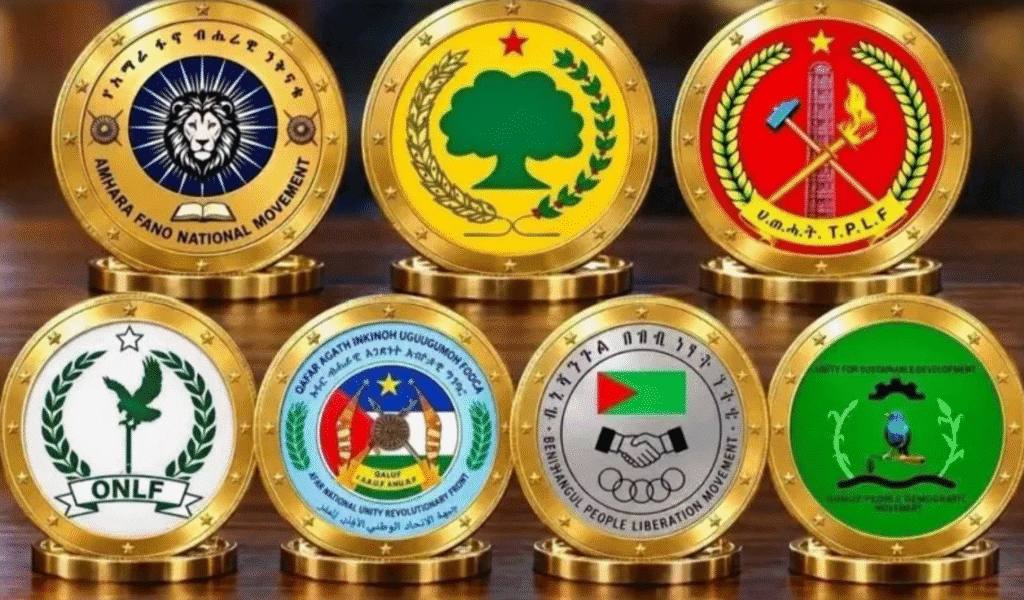
The press conference came one week after the coalition was publicly announced on September 20, 2026. In that recorded announcement, Amhara Fano National Movement chairman Zemene Kassie, introduced as the alliance’s first chair, read a three-page declaration announcing the establishment of the coalition. Seven organizations were named as founding members: the Amhara Fano National Movement, Oromo Liberation Army, Tigray People’s Liberation Front, Ogaden National Liberation Front, Afar Revolutionary Democratic Unity Front/Ugugumo, Benishangul Peoples’ Liberation Movement and Gumuz Peoples’ Democratic Movement.
The September 27 appearance went considerably further than that founding declaration.
Alliance officials said they had spent more than a year negotiating before publicly announcing the coalition. They described the organization primarily as a political alliance whose armed forces will also cooperate militarily, said common political negotiations with the federal government would be conducted jointly, disclosed the existence of an internal charter, code of conduct and “master plan,” and outlined both short- and long-term objectives for a proposed post-Prosperity transition.
Perhaps most significantly, the representatives attempted to address the central question surrounding the alliance since its formation: whether organizations carrying deep historical grievances and sharply different political programs can maintain a common front beyond their shared opposition to Abiy Ahmed’s government.
Their answer was essentially that they do not claim to have resolved all of those disputes. Instead, they said they have agreed that disputes involving identity, territory, constitutional arrangements and relations among Ethiopia’s peoples should ultimately be settled through political processes and decisions by the affected populations rather than through force.
Former adversaries sharing one platform
Four representatives introduced themselves at the beginning of the conference.
Henok Addis, deputy chairman for political affairs of the Amhara Fano National Movement, said he coordinates the alliance’s political committee.
Amanuel Assefa, deputy chairman of the TPLF, said he serves within the alliance and its political committee.
Jirenya Gudeta, representing the OLF/OLA, identified himself as an adviser to the commander-in-chief.
Abdurahman Mahdi, chairman of the Ogaden National Liberation Front.
Their appearance together was itself politically significant. Fano forces fought alongside the federal government against the TPLF during the 2020–2022 Tigray war, while territorial disputes involving areas claimed by both Amhara and Tigray remain unresolved. The OLA has simultaneously pursued its own long-running armed struggle in Oromia. The unusual composition of the coalition has therefore generated questions about whether opposition to Abiy Ahmed represents a sufficient basis for lasting cooperation. Contemporary reporting following the alliance’s formation similarly identified cohesion among former adversaries as one of its central challenges.
Henok presented precisely that history of conflict as part of the significance of the new organization. He described the participants as forces previously portrayed as incapable of sitting together politically but which had now gathered under what he called an existential necessity. The alliance, he said, was created because its members concluded that their separate conflicts were being exploited to keep them divided.
Alliance identifies removal of Prosperity Party government as immediate objective
There was little ambiguity during the conference about the coalition’s immediate objective. Henok said its primary goal was to protect what the alliance describes as the survival of Ethiopia’s peoples and the security of the country by removing what he called the Prosperity Party’s “individual dictatorial” system.
He listed four short-term goals:
- Removing the Prosperity Party government through the alliance’s military, political and diplomatic capacities.
- Establishing an inclusive transitional government involving political organizations, armed and peaceful opposition groups, nations and peoples, civil society and different sectors of society.
- Ending the country’s wars.
- Opening humanitarian-access routes to populations affected by conflict.
Alliance representatives repeatedly accused the Prosperity Party government of authoritarianism, war crimes, genocide and deliberately exploiting divisions among communities.
“Primarily a political collaboration”—but military forces are cooperating
One of the most consequential answers came when journalists asked whether the Alliance for Survival should be understood as a political organization, a military pact or both.
Amanuel Assefa described it primarily as a political alliance.
“Armed struggle is a political instrument,” he argued, saying the member organizations possess political demands that, in their assessment, can no longer be pursued effectively through peaceful channels. He then went further. The armed forces associated with alliance members, Amanuel said, will cooperate militarily, and fighters belonging to different member organizations were already “paying sacrifice together” as he spoke.
When the coalition was first declared, its public statement spoke about coordinating the participating organizations’ capacities but provided little information about a unified command, integrated military structure or mechanism for conducting joint operations.
Negotiations would be joint on common issues
The alliance also addressed whether individual members could independently negotiate with the federal government.
Amanuel said the coalition’s political documents distinguish between common and organization-specific issues. According to him, common political questions would be negotiated jointly, while issues unique to a particular organization could potentially be handled separately. He added, however, that developments had increasingly transformed formerly separate disputes into common questions.
The alliance simultaneously maintained that the present government had closed meaningful avenues for peaceful political settlement. Amanuel said the coalition had concluded that there was currently “no peaceful political alternative,” which alliance officials cited as their justification for armed struggle. That position is especially consequential because one member, the TPLF, signed the Pretoria Cessation of Hostilities Agreement in November 2022, which formally ended the previous large-scale war between the federal government and Tigrayan forces.
What would replace the current government?
Alliance representatives devoted substantial attention to the question journalists repeatedly raised: What happens if the Prosperity Party government is removed?
Their answer was a transitional government.
Henok said the coalition envisages a transition involving nations and peoples, political organizations, peaceful opposition groups, armed groups fighting the government, civil society and different sections of Ethiopian society.
Amanuel said the alliance has already prepared documents intended to guide such a process, including:a transitional charter; a code of conduct governing relations among coalition members; and what he called a joint master plan. He said those documents were developed during more than a year of negotiations among participating organizations. The documents themselves, however, were not presented in full during the press conference. That leaves major questions about institutional design, the duration of a transition, allocation of authority, constitutional procedures and security arrangements unanswered publicly.
Long-term program: dialogue, elections, security restructuring and transitional justice
Henok outlined five longer-term objectives.
The alliance says a transitional process should facilitate popular and constitutional dialogue over fundamental political questions; restructure Ethiopia’s defense, police and security institutions; pursue economic and social justice; create a multiparty democratic system with free elections, independent media and an independent judiciary; and establish mechanisms of transitional justice and accountability.
One element was emphasized repeatedly: alliance leaders said they are not presenting predetermined answers to Ethiopia’s disputed national questions. Questions involving identity, boundaries and constitutional arrangements, Henok argued, should ultimately be decided by the affected populations.
“We did not come with answers from our pockets,” he said in substance. “We came with a platform that gives answers.” That formulation appears designed to bridge some of the coalition’s most difficult contradictions without resolving them immediately. Whether it can do so in practice is likely to become one of the most consequential tests of the alliance.
How would Fano, TPLF and OLA resolve disputes?
Journalists repeatedly returned to the history of conflict among coalition members.
Alliance representatives acknowledged rather than denied those divisions. Amanuel said their collective history contained “much hatred” and said an agreed code of conduct sets out mechanisms for addressing disputes. Jirenya Gudeta said every member remains an independent organization with its own leadership and political program. He rejected suggestions that one organization, particularly the TPLF, dominates the others. According to Jirenya, participating groups have equal voices and equal participation in alliance decision-making. Decisions are intended to be reached by consensus and, where consensus becomes impossible, by a two-thirds mechanism. That was one of the most concrete organizational details disclosed during the conference. It also indicates that the alliance has not merged its constituent organizations into a single movement.
Tactical alliance or strategic alliance?
Another question raised by journalists concerned whether the coalition is merely a temporary arrangement created to fight Abiy Ahmed or represents a deeper political realignment. Jirenya argued that the coalition’s shared strategic objective is peace, and that tactical cooperation can develop into longer-term strategic cooperation. He said difficult political questions should be narrowed through negotiation and, where necessary, taken directly to the people concerned for decision.
Amanuel said the coalition’s immediate strategic objective is removing what its members view as the system threatening their communities, followed by a transitional arrangement intended to produce longer-term peace, security and democracy.
Who else can join?
Henok said the alliance should not be understood as permanently limited to seven organizations. He said other forces that accept its central objective could participate and that organizations outside the existing coalition would also have representation in a future transitional process. He specifically said the Southern and Gambella Peoples’ Movement representing close to 50 nationalities had applied to join the coalition.
The alliance’s composition itself has also generated controversy within some of the organizations and constituencies whose names appear in the coalition. Outside commentary since the formation announcement has reported internal disagreement over participation, including competing claims surrounding representation of the ONLF.
Abdurahman Mahdi, representing the Ogaden National Liberation Front, was questioned about competing claims over the ONLF’s participation in the Alliance for Survival. Journalists raised three issues: a separate ONLF faction that has said it is not part of the alliance; comments by an ONLF spokesperson who said the organization had joined the alliance but would not participate militarily; and the fact that the ONLF is registered with Ethiopia’s National Election Board.
Mahdi rejected the suggestion that these points undermine the ONLF’s participation. He said creating rival factions within opposition organizations has been a recurring tactic of the Prosperity Party government, citing what he said was a similar experience involving the Oromo Liberation Front. He also argued that the ONLF’s political existence does not originate from its registration with the National Election Board of Ethiopia, noting that the organization had been engaged in armed struggle for about 43 years before signing a peace agreement with the federal government in 2018. He accused the Prosperity Party government of failing to implement that agreement. Regarding the spokesperson’s comments, Mahdi said they had been misrepresented. He confirmed that, in his account, the ONLF is a full participant in the Alliance for Survival in all aspects, including military cooperation aimed at defending the people.
Foreign support and Eritrea
Journalists also asked about federal government accusations that members of the alliance are receiving support from Eritrea and other foreign governments.
Amanuel argued that Ethiopia’s deteriorating relations with neighboring countries are themselves consequences of federal government policy and said those countries have their own security interests. He described alliance members as Ethiopian organizations operating among communities inside Ethiopia and argued that cooperation with others facing common threats should not automatically be treated as illegitimate. The answer did not disclose what relationships, if any, individual alliance members maintain with Eritrea or other governments.
International community accused of favoring government
Alliance representatives also criticized recent statements from foreign governments and international actors.
The United States, UK, France, Japan, Qatar and UAE explicitly attributed significant responsibility for the immediate escalation to the TPLF/Tigrayan forces.
The UAE went furthest in explicitly expressing solidarity with the federal government and rejecting attempts to change Ethiopia’s constitutional order by armed force.
The UK separately rejected the Alliance for Survival’s stated objective of overthrowing the government.
The AU and IGAD centered the Pretoria framework and immediate de-escalation. The AU nevertheless specifically criticized Tigrayan forces’ takeover of the three airports and expressed concern about the newly formed political-military alliance. IGAD’s wording was less explicitly accusatory and addressed its ceasefire demand to all parties.
The EU gave one of the more balanced descriptions of the immediate military context. It cited both the TPLF takeover of the airports and earlier Ethiopian National Defence Force drone strikes, before demanding de-escalation and renewed implementation of Pretoria.
Russia’s emphasis was different. Ethiopia’s territorial integrity, compliance with existing agreements and opposition to outside interference. Moscow referred to the Tigrayan forces as “illegal” armed groups.
Despite different language about responsibility, a remarkably consistent diplomatic message runs through the statements: avoid another full-scale war; protect civilians; return to political dialogue; and use the November 2, 2022 Pretoria Agreement and AU mediation as the principal framework for resolving the crisis. There is also an important omission across most of these statements. They focus primarily on the September 23 military escalation, rather than providing a detailed assessment of the unresolved Pretoria obligations, earlier drone attacks, contested territories, displaced populations, or the political developments that preceded the renewed fighting.
In this context, Amanuel argued that some Western governments consider the Prosperity Party government the more predictable partner for maintaining regional security and therefore approach opposition forces with suspicion. He said the alliance needs to demonstrate that it can present itself as a credible alternative capable of contributing to peace and security in Ethiopia and the Horn of Africa.
The alliance itself issued a statement on September 24 rejecting what it said was the AU’s characterization of the coalition and calling instead for a broader examination of Ethiopia’s political crisis.
What does “dismantling the empire” mean?
One of the politically sensitive questions was directed to Jirenya after comments attributed to him about dismantling Ethiopia’s “empire.”
He drew a distinction between dismantling Ethiopia and dismantling what he described as an imperial political system. According to Jirenya, an empire is a structure that holds peoples together through coercion, whereas a country should rest on consent and a political or social contract among its peoples. He explicitly said the alliance was not calling for the physical breakup of Ethiopia or separation of its peoples.
“What we say is the empire system, the system of subjugating peoples by force, must fall,” he explained in substance.
That clarification is significant because the future territorial integrity and constitutional structure of Ethiopia has become one of the central anxieties surrounding the coalition. The alliance’s stated position at this press conference was that those questions should ultimately be determined through political dialogue and popular participation rather than imposed by any one of its member organizations.
Media structure still being developed
The conference also exposed areas where the alliance remains institutionally incomplete. Asked whether members have a common media policy and whether military information will be centrally coordinated, Henok said work had begun to establish a media committee. He said a common media manual would be derived from the coalition’s political program, code of conduct and broader organizational documents. His answer indicated that centralized communication structures remain under development.
Will the alliance for survival formula survive and what comes next
Whether that formula can survive the battlefield, the unresolved histories among its members, competing territorial claims and the pressures of an eventual transition is now one of the major questions confronting Ethiopia’s rapidly changing political and military landscape.
If the commitments made at the press conference are sustained, one immediate positive consequence could be reducing the danger of a broader horizontal war among Ethiopia’s peoples and regions. Forces associated with Amhara, Tigrayan, Oromo and other constituencies are now publicly committing to resolve major disputes politically rather than through war against one another.
The next question is whether the alliance can translate that cooperation into discipline on the ground, protecting civilians, containing old territorial and political disputes, and preventing renewed intercommunal conflict.
The second test is diplomatic. Several international actors have so far viewed the alliance with concern and have criticized some of its members’ military actions. The alliance will now have to demonstrate through its conduct, political program and internal discipline that it can be part of a broader political settlement rather than another source of instability.
The most urgent question is whether the alliance can generate enough political, military and diplomatic pressure to force meaningful negotiations before the war causes further humanitarian devastation.
The central issue, therefore, is no longer only whether the alliance can remain united. It is whether that unity can help reduce horizontal conflict, change international perceptions and create sufficient leverage for serious negotiations before civilians once again bear the greatest cost.